

Prune free-standing apple trees in winter, while they are dormant: from leaf fall in November until early March. Trained apples (cordons, espaliers, fans and stepovers) get their main prune in summer instead, from mid- to late August, about ten days later in the north. In a normal year, take off no more than a fifth of the canopy; even an old tree being rescued should lose no more than a quarter.
By Linda Garrould · Updated 3 October 2026 · Timings checked against RHS guidance
The short version
- Bush, half-standard and standard trees: winter, between leaf fall and early March, on a dry day above freezing.
- Cordons, espaliers and fans: the main prune is in summer, from mid- to late August (stepovers usually in September), when the bottom third of the new shoots has turned woody. In winter, only thin out crowded spurs.
- Old, overgrown trees: renovate in winter, removing no more than a quarter of the canopy a year, over two or three years.
- How much: about 10 to 20 per cent of the canopy in a normal winter. A tree cut back too hard replies with a thicket of upright shoots and fewer apples.
- Reading this in October? Put the saw away until the leaves are down. This is the month to put grease bands on the trunks instead.
Apple trees are generous and long-suffering, and the commonest mistake made with them is not neglect but enthusiasm. A tree pruned hard every winter becomes a tree full of leaves. Get the season right for the kind of tree you have, recognise where its fruit buds sit, and stop before you have taken too much, and an apple tree will crop for decades. The timings below are checked against the Royal Horticultural Society’s fruit guidance, and they follow one principle.
The one rule
Winter pruning grows a tree; summer pruning holds it back
Prune in winter and the tree answers with strong new growth the following spring. Prune in summer and it does not. That single fact explains the whole apple calendar.
A free-standing tree, the kind most of us have in a lawn or at the end of the garden, needs a framework of strong branches and room for light and air in the middle. Winter, when the leaves are off and you can see the shape, is the time to build and maintain that framework. A trained tree, flattened against a wall or wires as a cordon, espalier or fan, is the opposite problem. It must be kept small and neat, and every vigorous shoot is unwanted. So its main prune comes in late summer, when cutting the season’s growth back encourages fruit buds rather than more leafy shoots.
If it stands on its own, prune it in winter. If it is trained flat, prune it in summer.
The calendar
When to prune apple trees, month by month
November to February
The main winter pruning season for bush, half-standard and standard trees, for formative pruning of young trees, and for renovating old ones. Start once the leaves have fallen and you can see the tree’s structure clearly. Choose dry days that are above freezing.
Early March
The last of the winter window. Finish before the buds break; once the tree is in growth, put the saw away until summer.
Late June to mid-July
The tree sheds some fruitlets of its own accord in the so-called June drop. Once that is over, thin what remains (see thinning) and finish by mid-July.
Late July to September
Summer pruning for trained trees: pears are usually ready from late July, apples from mid- to late August, and gardens in the north about ten days later. Before you start, check hedges and wall-trained trees for nesting birds.
September and October
Trim back any regrowth on trained trees that sprouts after the summer prune. Pick the crop. In late October, before the winter moths emerge in November, put grease bands around trunks and stakes about 45cm above the soil, and wait for the leaves to fall.
By type of tree
When to prune each kind of apple tree
This is the table to bookmark. Find your tree in the left-hand column.
| Your tree | When to prune | What the prune is for |
|---|---|---|
| Bush, half-standard or standard (free-standing, on a single trunk) | Winter: leaf fall to early March | Keep an open, goblet-shaped framework; remove dead, diseased, crossing and crowded wood; thin old spurs. 10 to 20 per cent of the canopy at most. |
| Cordon (a single stem, usually planted at 45 degrees) | Summer: mid- to late August. Winter: thin crowded spurs only | Shorten the season’s sideshoots to build short fruiting spurs along the stem. |
| Espalier (horizontal tiers against a wall or wires) | Summer: mid- to late August. Winter: tidy and thin spurs | As for a cordon, along each tier; keep the arms horizontal and the centre in check. |
| Fan | Summer: mid- to late August. Winter: tidy | Shorten sideshoots on the ribs of the fan; tie in replacement shoots where gaps appear. |
| Stepover (a single low tier, 45–60cm high) | Late summer, once the shoots stop growing; September suits many | A one-tier espalier: the same summer rules, on a very small scale. |
| Young tree (first three years) | Winter | Formative pruning to build the framework (see young trees). |
| Old or neglected tree | Late autumn to late winter | Staged renovation: up to a quarter of the canopy a year, over two or three years. |
| Tree in a pot | As for its form: winter for a bush, summer for a trained tree | Usually on a dwarfing rootstock such as M26 or M9, so pruning is light; keep it compact and well fed. |
Know your tree
Spur-bearer or tip-bearer? Check before you cut
Most apple varieties fruit on spurs: short, knobbly, many-budded shoots on wood that is two or more years old. A minority also fruit at the tips of last year’s shoots, and pruning those like a spur-bearer cuts the crop off. It takes a minute to tell which you have, and winter is the easiest time to look.
Spur-bearers include ‘Cox’s Orange Pippin’, ‘James Grieve’, ‘Sunset’, ‘Greensleeves’ and ‘Lane’s Prince Albert’. They take routine winter pruning well, and their spurs can be thinned as they age.
Tip-bearers and partial tip-bearers carry fruit buds at the ends of shoots as well as on some spurs. The RHS names ‘Bramley’s Seedling’, ‘Discovery’, ‘Worcester Pearmain’, ‘Blenheim Orange’ and ‘Lord Lambourne’ among the partial tip-bearers, and ‘Irish Peach’ and ‘Cornish Gilliflower’ as tip-bearers. Their rule is restraint: leave the shorter tipped shoots alone, and shorten older, long branches that have already fruited by up to a quarter, back to a strong younger sideshoot, rather than shortening everything. Tip-bearers are also a poor choice for cordons and espaliers, which depend on spur pruning.
The winter prune
How to winter-prune an established apple tree
For a free-standing tree that is already in shape, the annual winter prune is a matter of an hour or two. Work in this order, stepping back every few cuts to look at the whole tree.
- Take out the three Ds. Remove dead, diseased and damaged wood first, cutting back into healthy wood or to the branch collar.
- Remove crossing and rubbing branches, keeping whichever of the pair is better placed. Bark rubbed raw is an entry point for disease.
- Open the centre. Thin crowded growth in the middle of the tree so light reaches the fruit and air moves through the canopy, aiming for a rough goblet shape.
- Deal with watershoots. These are the vigorous, straight upright shoots that spring from the main branches. Remove most of them where they arise; if there is a gap in the framework, keep one well-placed shoot to fill it.
- Thin the spurs on older trees. Spur systems become congested with age. Thin them so they are about 10 to 15cm apart, removing the weakest and the ones on the underside of branches first.
- Stop at a fifth. The RHS aims for 10 to 20 per cent of the canopy in any one winter. In a routine winter prune, avoid removing branches more than 10 to 12cm across. Avoid giving the tree a “haircut”: shortening every shoot by a few inches produces a mass of leafy growth and very little fruit.
If the tree is getting too big, read on to old and neglected trees. Height comes down over several winters, never all at once.
The summer prune
Summer pruning cordons, espaliers, fans and stepovers
The main prune for a trained apple tree is in late summer: from mid- to late August in most of the UK, about ten days later in the north, and from late July for pears. The cue is the shoots themselves: they are ready when the bottom third of each new shoot has turned stiff and woody.
- New sideshoots growing straight from the main stem or arm and longer than about 20cm: cut back to three leaves above the basal cluster, the tight rosette of leaves where the shoot begins.
- Shoots growing from existing sideshoots or spurs: cut back to one leaf above the basal cluster.
- Shoots shorter than 20cm: leave them. Many will form fruit buds at their tips.
RHS guidance varies slightly here: its page on established cordons cuts the longer sideshoots back to one leaf beyond the basal cluster rather than three. Both work. The one-leaf version keeps a cordon tighter, and the three-leaf version is a little more forgiving. If the tree sends out more shoots after the summer prune, cut them back to one leaf in September or October.
In winter, a trained tree needs only a tidy: thin out congested spurs, and cut back any overlong sideshoots missed in summer to a short stub. When a cordon reaches the top of its support, the RHS suggests lowering it gradually, from 45 degrees towards 35, to give it more length rather than letting it shoot skywards.
Before summer pruning, check for nests. Wall-trained fruit and the hedge behind it are favourite nesting spots. Under the Wildlife and Countryside Act 1981, it is an offence intentionally to damage or destroy the nest of any wild bird while it is being built or in use. If you find one, leave that section until the young have flown.
Formative pruning
Pruning a young apple tree: years one to three
The first three winters set the shape of the tree for the rest of its life. The RHS sequence for a free-standing bush tree runs like this.
| When | What to do |
|---|---|
| Planting winter: an unbranched one-year tree (a “maiden whip”) | Cut the stem back to about 75cm (2½ft) from the ground, or 60cm on a very dwarfing M27 rootstock, just above a bud. Sideshoots will form below the cut. |
| Planting winter: a “feathered” maiden (already has sideshoots) | Choose three or four well-spaced, wide-angled sideshoots to form the first branches, cut the main stem back to just above the topmost of them, shorten each chosen shoot by a half to two-thirds, and remove the rest. |
| Second winter | Choose eight to ten shoots to form the main framework and shorten each by a third to a half; remove shoots growing into the centre, and if a strong upright shoot appears in the middle, take it out entirely. |
| Third winter | Shorten the new growth on the leading branches by about a quarter. From now on, prune as an established tree. |
If you planted an unbranched whip, it runs a year behind: in its second winter, give it the feathered-maiden treatment, then the eight-to-ten-shoot step the winter after.
For a half-standard or standard, the principle is the same, but you first grow a clear trunk: about 1.2 to 1.5m for a half-standard and 1.8 to 2.1m for a standard, removing sideshoots below that height.
Renovation
Pruning an old, overgrown or neglected apple tree
Renovate an old tree in stages, between late autumn and late winter, removing no more than a quarter of the canopy in any one year, spread over two or three years. That is the RHS limit, and it is the single most important number on this page for anyone who has inherited an orchard tree. Go harder and the tree responds with a forest of upright watershoots, more shade, and fewer apples than before.
- Year one: take out the dead, diseased and damaged wood, then one or two of the largest crossing or badly placed branches.
- Year two: open the centre and begin lowering the height, cutting tall branches back to a lower, outward-facing side branch rather than to a stump.
- Year three: finish thinning, deal with the watershoots that followed earlier cuts, and thin congested spurs.
The RHS advises against removing branches more than 20cm (8in) across, which leave wounds too large for the tree to seal well. If a tree needs that kind of surgery, or you would need to work at height with a chainsaw, call a qualified arborist. Old orchard trees are also valuable for wildlife, and wildlife charities such as the Woodland Trust suggest leaving some safe deadwood in place rather than stripping an old tree clean.
Once a mature tree is the size you want, regulated pruning keeps it there with little effort. The RHS suggests it for bush and standard trees at least seven to ten years old. Leave most of the young growth alone, and each winter remove some of the older wood and anything crossing, crowded or congested.
The cut
How to make the cut
When you take off a branch, cut just outside the branch collar: the slightly swollen ring where the branch joins the trunk or a larger limb. Do not cut flush with the trunk, and do not leave a stub. The collar contains the tissue that grows over the wound; cut into it and the wound heals slowly, and a stub dies back and rots.
For smaller shoots, cut just above a bud that faces the way you want the new growth to go, usually outwards, with a clean, slightly sloping cut. On heavier branches, take the weight off first: make a shallow cut on the underside a short way out from the trunk, then cut through from above a little further out, and finally remove the short stub that is left with a clean cut at the collar. This stops the falling branch tearing a strip of bark from the trunk.
Disease
Canker, and whether to paint the cuts
For routine pruning cuts on apples and pears, do not use pruning paint. The RHS no longer recommends it; a clean cut in the right place seals itself.
The exception is apple canker, a fungal disease that shows as round or oval patches of sunken, dead bark, often with rings of cracked bark around the edge. Prune out small cankered shoots and spurs completely. On larger branches, cut the canker back to clean, healthy tissue. For this case, the RHS advises painting the wound with a protective wound paint straight away. Burn or bin the cankered wood, and never put it on the compost heap. ‘Cox’s Orange Pippin’, ‘James Grieve’, ‘Ribston Pippin’, ‘Spartan’ and ‘Worcester Pearmain’ are among the more susceptible varieties.
After pruning
Thinning the fruit after the June drop
Thinning is not pruning, but it belongs on the same calendar, and it does more for the size and flavour of the crop than any cut you make in winter. Once the tree has shed its surplus fruitlets in the June drop, thin what remains by mid-July:
- Dessert apples: one or two fruits every 10 to 15cm along the branch.
- Cooking apples: one fruit every 15 to 23cm.
- Reduce each cluster to one fruit (two at most for dessert apples), taking out any misshapen or damaged ones first, usually including the central “king” fruit, which is often misshapen.
Thinning also helps break the habit some varieties have of biennial bearing: a glut one year and almost nothing the next.
Troubleshooting
Why isn’t my apple tree fruiting?
If a tree flowers poorly or crops little, pruning is often the cause. Run through the usual suspects:
- Too much pruning. According to the RHS, a tree that makes vigorous shoots at the expense of fruit has often had too much wood taken out in one year. Prune less, for a year or two, and remove most of the watershoots.
- A tip-bearer given a haircut. Shortening every shoot of a ‘Bramley’ or ‘Discovery’ removes the fruit buds.
- Frost on the blossom. A late spring frost can kill open flowers, with no fault of yours.
- No pollination partner. Most apples need another apple or crab apple flowering at the same time nearby, unless the variety is self-fertile.
- Biennial bearing. A heavy crop last year can mean a light one this year; thinning helps even it out.
- Drought. A lack of water while the fruit sets and swells cuts the crop, and dry, hungry years can tip a tree into biennial bearing.
- Too young. A newly planted tree can take a few years to crop.
Rootstocks
How big will my apple tree get?
An apple tree’s final size is set mainly by its rootstock, not by pruning, and pruning a vigorous tree hard to keep it small makes things worse. If you know the rootstock (it is usually on the original label), the RHS figures are a good guide:
| Rootstock | Typical height | Good for |
|---|---|---|
| M27 | 1.2–1.8m | Very small gardens, pots, stepovers |
| M9 | 1.8–2.4m | Small bush trees and cordons |
| M26 | 2.4–3m | Containers, cordons, espaliers, small bushes |
| MM106 | 3–4m | The most widely used: bush trees in an average garden |
| MM111 | 4–4.5m | Half-standards and standards |
| M25 | 4.5m and over | Full standards in orchards and large gardens |
Other fruit
Pears, plums and cherries: the same, and not the same
Pears follow the apple rules exactly, except that trained pears are ready for their summer prune earlier, from late July.
Plums, cherries, gages and other stone fruit must not be pruned in winter. Winter cuts leave them open to silver leaf, a fungal disease that can kill branches. The RHS advises pruning young plum trees in spring and established ones in midsummer. If you have apples and plums side by side, prune them in different seasons.
The kit
The apple-pruning kit worth buying
Use bypass tools on living wood. Bypass secateurs and loppers cut like scissors and leave a clean wound. Anvil types crush as well as cut, which is fine on dead wood but not on a branch you want to heal. Keep every blade sharp, and wipe the blades between trees if you have cut out canker.
A word on ladders: a fall from a ladder does far more harm than any slip of the secateurs. A long-reach pruner and a pole saw let you make most high cuts with both feet on the ground. If you do climb, use a stable tripod orchard ladder on firm, level ground, and have someone with you.
Affiliate links: as an Amazon Associate, Saturday & Sunday earns from qualifying purchases. It costs you nothing extra and helps keep the site running. We chose these on specification and the makers’ reputations; no brand paid to be included. Availability and links were checked on 3 October 2026 and can change.
For cutting


Felco No. 2 bypass secateurs
The orchard standard. Bypass action, a 25mm cutting capacity and a sap groove; every part is sold separately, so a worn pair is repaired, not replaced. Sized for medium to large hands.
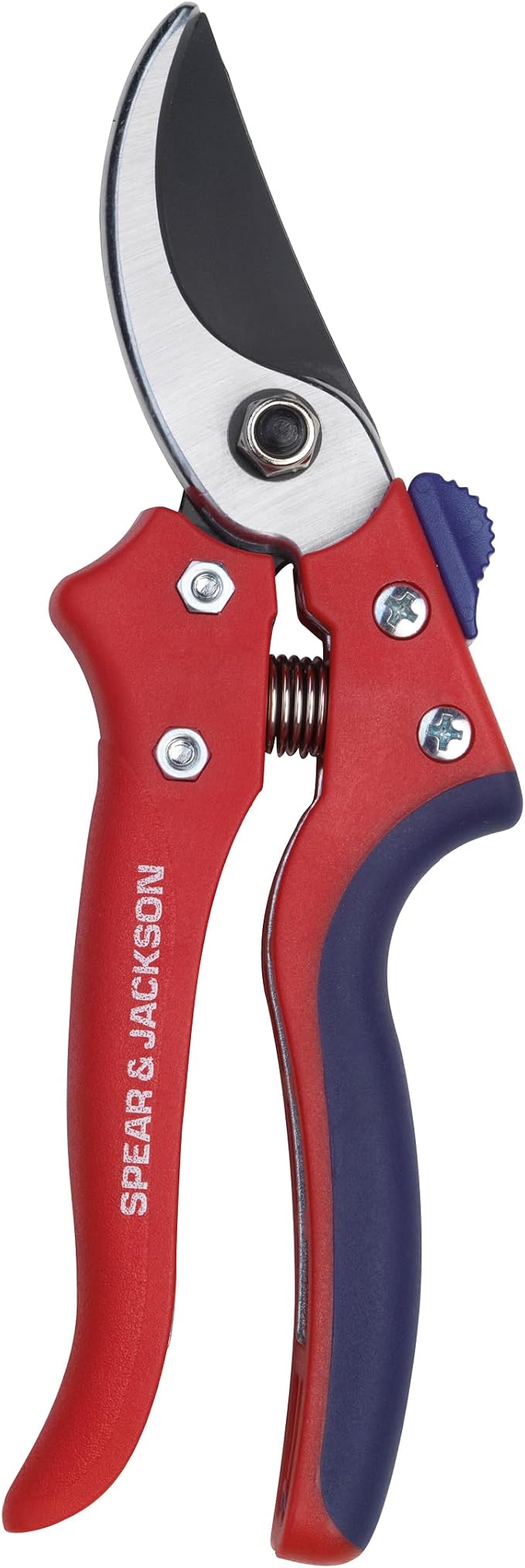

Spear & Jackson Razorsharp Advantage bypass secateurs
The good-value pair. For one or two trees pruned once a winter, a sharp bypass blade matters far more than the badge on the handle.


Spear & Jackson Razorsharp telescopic ratchet bypass loppers
Telescopic handles for reach and a ratchet for thicker wood, with a bypass blade for clean cuts on living branches.


Silky Zubat curved pruning saw
A 330mm curved blade in a scabbard: the saw for taking out a whole limb or renovating an old tree, cutting just outside the collar.


Silky Pocketboy 170 folding saw
A smaller folding saw that lives in a coat pocket, for branches too thick for loppers on a young or medium tree.


Fiskars PowerGear X telescopic tree pruner
A pole pruner for the high branches, so the cuts at the top of a standard can be made from the ground rather than the top of a ladder.
For thinning and winter care


Bellota bypass harvesting snips
Narrow, pointed snips that reach into a tight cluster of fruitlets, which makes thinning after the June drop quick and clean.


Vitax fruit tree grease
Applied in late October straight onto the bark or onto a paper band, about 45cm up the trunk and stake, it catches wingless female winter moths as they climb to lay their eggs.
More from the gardening calendar
- When to prune roses: every type, every month, and the cut that counts.
- When to prune hydrangeas: old wood or new wood, and why it matters.
- When to prune lavender: the one cut a year that keeps it from going woody.
- How to start composting: put healthy prunings through a shredder for the heap; cankered wood never goes in.
- Gifts for gardeners: for the person who already owns the secateurs.
Common questions
Apple tree pruning: frequently asked questions
When is the best time to prune apple trees in the UK?
For free-standing trees (bush, half-standard and standard), prune in winter while the tree is dormant, between leaf fall in November and early March. Trained trees, such as cordons, espaliers and fans, get their main prune in summer instead: mid- to late August for apples, about ten days later in the north, and usually September for stepovers.
Can I prune my apple tree in October?
Not yet. Wait until the leaves have fallen, usually in November, so you can see the framework of the tree and it is fully dormant. The winter window then runs until early March.
Can I prune an apple tree in summer?
Yes, if it is a trained form such as a cordon, espalier, fan or stepover: summer is when these get their main prune, from mid- to late August once the bottom third of the new shoots has turned stiff and woody. Free-standing trees are pruned in winter, although you can remove watershoots and dead wood from them in summer.
What month is too late to prune apple trees?
Aim to finish winter pruning by early March, before the buds break. Pruning once growth is under way wastes the tree’s effort and risks damaging blossom.
How much can I cut off an apple tree in one go?
In a normal winter, remove about 10 to 20 per cent of the canopy. When renovating an old, neglected tree, the RHS limit is up to 25 per cent a year, spread over two or three winters. Taking more provokes a thicket of vigorous upright watershoots and less fruit.
Do apples grow on old wood or new wood?
Most apple varieties fruit on short spurs that form on wood two or more years old. Tip-bearers and partial tip-bearers, such as ‘Bramley’s Seedling’, ‘Discovery’ and ‘Worcester Pearmain’, also carry fruit buds at the tips of the previous year’s shoots.
How do I know if my apple tree is a tip-bearer?
In winter, look at the ends of last year’s shoots. If many of them finish in a plump, rounded fruit bud, and the tree has relatively few spurs, it is a tip-bearer or partial tip-bearer. Leave those tipped shoots unpruned and thin out some older shoots instead.
Can I cut the top off my apple tree to make it shorter?
Not in one go. Lopping the top off a tree triggers a mass of upright watershoots. Lower it gradually over several winters by cutting tall branches back to a lower, outward-facing side branch, within the 25 per cent-a-year limit for renovation.
Should I seal or paint pruning cuts on an apple tree?
No. The RHS does not recommend pruning paint for routine cuts on apple or pear trees; a clean cut just outside the branch collar heals on its own. The one exception the RHS gives is after cutting out apple canker, when it advises a protective wound paint.
Should I prune apple trees in frosty weather?
It is best avoided. Pick a dry day above freezing: frozen wood is brittle and can split, and wet weather helps fungal spores, such as those of canker, reach fresh cuts.
Do I prune pear trees at the same time as apples?
Yes, pears follow the same rules: winter pruning for free-standing trees and summer pruning for trained ones. The one difference is that trained pears are ready for their summer prune a little earlier, from late July.
Can I prune plum and cherry trees in winter like apples?
No. Plums, cherries and other stone fruit should not be pruned in winter, because it increases the risk of silver leaf disease. Prune young stone-fruit trees in spring and established ones in summer.
Written by Linda Garrould. Timings and methods checked against Royal Horticultural Society fruit guidance. First published 3 October 2026.
GardeningFruit treesApplesPruningUK garden calendar


0 Comments