
If I'm up late, I end the day with the Shipping Forecast on BBC Radio 4: 'Sailing By', then a slow tour of the map from Viking round to South-east Iceland. This guide gathers the Shipping Forecast gifts and merchandise I'd buy for the Radio 4 fans in my own family — sea-area maps and prints, tea towels, a good mug, t-shirts and the books worth reading — with a note on the poems and the music fans will already know. If you're after a present for a weather lover, a sailor or a late-night listener, start here.
For Radio 4 households: our Archers gift guide and reading list, and the books on BBC Radio 4 this month.
By Linda Garrould · Last refreshed: 4 October 2026. We checked every link and listing on that date; availability can change, and we update the guide when it does.
As an Amazon Associate I earn from qualifying purchases. This means if you click a link and buy, I may receive a small commission at no extra cost to you. It helps keep the site running and the kettle on.
Sea-area maps, posters & wall art
Prints, charts and posters of the 31 shipping forecast sea areas — handsome on a kitchen wall, irresistible to anyone who loves a map.


United Kingdom Shipping Forecast Regions Map (A2 Size 42 x 59.4 cm)


Shipping Forecast A3 print
A smaller, handmade alternative to the big chart above: an original coastal design at A3, easy to frame for a study, hallway or boat.
Books about the Shipping Forecast
From Charlie Connelly's much-loved travelogue to Peter Jefferson's insider memoir and Peter Collyer's coast-by-coast watercolours — the books that explain why this little weather bulletin has lasted a century.
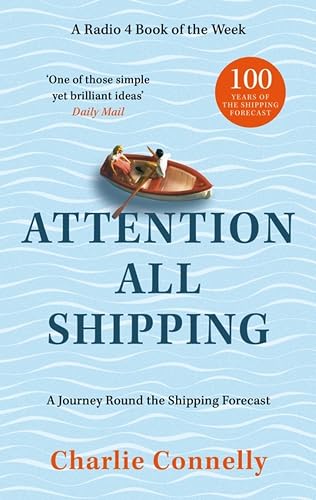

Attention All Shipping: A Journey Round the Shipping Forecast
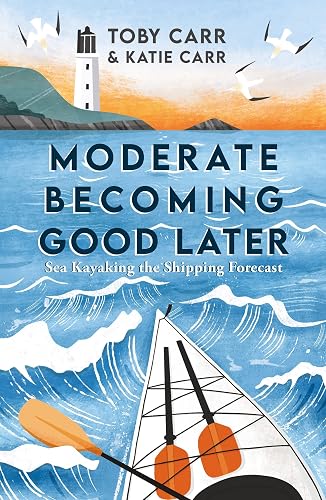

Moderate Becoming Good Later: Sea Kayaking the Shipping Forecast – as seen on the BBC Travel Show


The Shipping Forecast: A Miscellany


And Now The Shipping Forecast: A tide of history around our shores


The Shipping Forecast Puzzle Book


Rain Later, Good: Painting the Shipping Forecast
Tea towels, mugs & kitchen gifts
Tea towels and a mug printed with the sea areas: the classic Radio 4 present for birthdays, retirements or anyone who turns the radio on while they wash up. Good Shipping Forecast mugs are surprisingly scarce; the Dunoon bone-china one is the one we would buy. The tea towels are the bargain of the guide, and two of them are as happy in a frame as by the sink.


Dunoon Fine Bone China Glencoe Shaped Mug – British Isles Shipping Forecast


Shipping Forecast Area Tea Towel
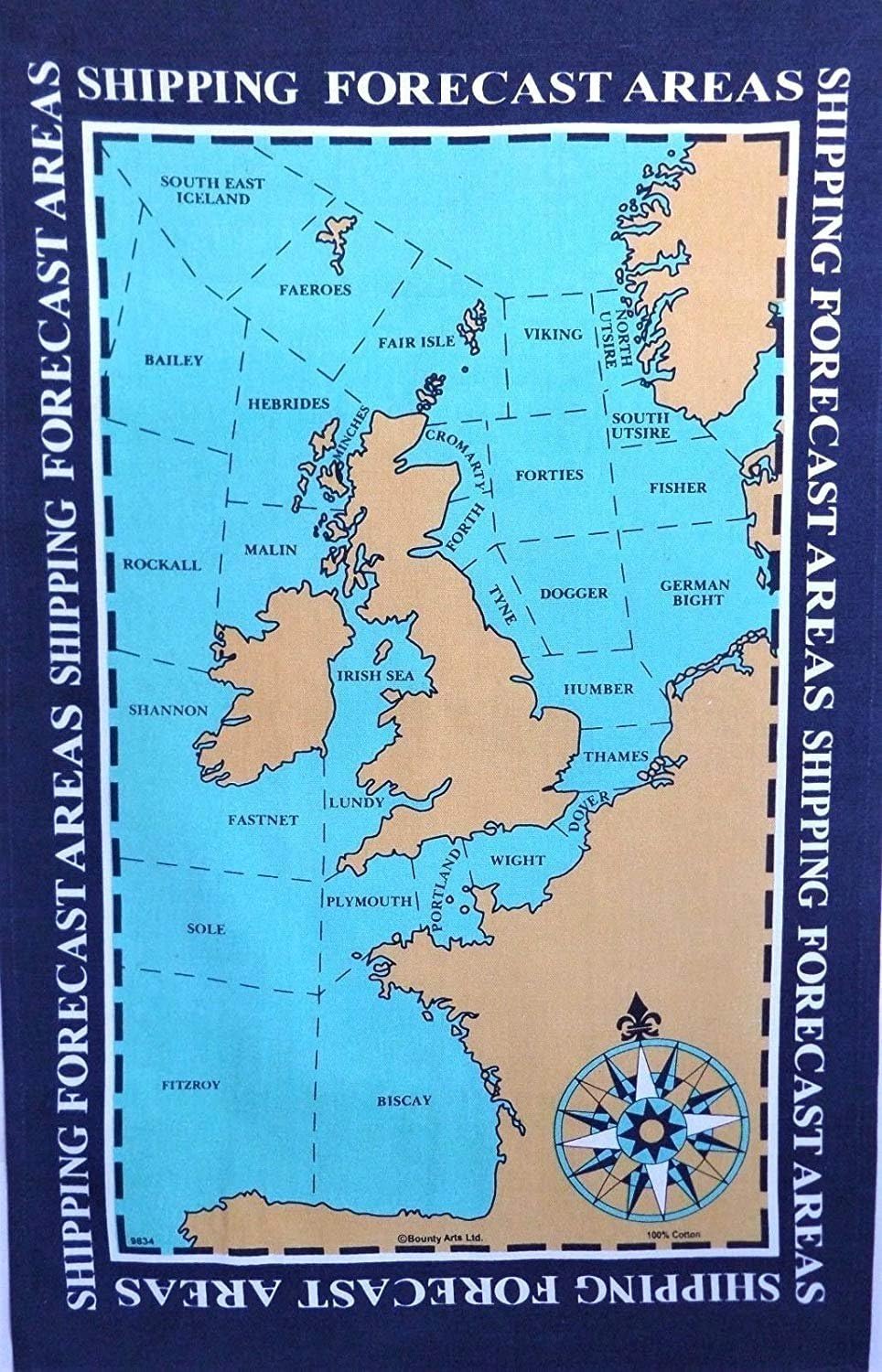

Shipping Forecast Galley Cloth Tea Towel
A cotton galley cloth printed with the British Isles and the sea areas, from Bailey and Rockall round to Dover and Wight. Hemmed on all four sides; 75 x 47cm.


UK Shipping Forecast Areas Coastguard Galley Cloth / Fabric Poster / Tea Towel
Cotton, 75 x 45cm, and designed to be framed as a fabric poster as readily as hung by the Aga. The cheapest way to put the sea areas on a wall.
Shipping Forecast t-shirts & clothing
A Shipping Forecast t-shirt is the easiest bit of merchandise to wrap and post — printed with the sea areas or a wry forecast pun, it's a good-natured gift for a weather-lover or a Radio 4 fan who already has the books and the mug. Both were in stock on Amazon UK when we checked on 4 October 2026.


Shipping Forecast Sea-Areas Gift T-Shirt


'Moderate or Good, Occasionally Poor' Funny Shipping Forecast T-Shirt
The poems, the music and the people behind the forecast
Ask a real enthusiast and the conversation turns quickly from tea towels to the forecast's afterlife in print. Seamus Heaney opens the seventh of his Glanmore Sonnets, in Field Work (1979), with a roll-call of sea areas: “Dogger, Rockall, Malin, Irish Sea”. Carol Ann Duffy's “Prayer”, from Mean Time (1993), ends on the radio's own litany — “Rockall. Malin. Dogger. Finisterre.” — which is why so many fans still say Finisterre two decades after the area became FitzRoy. Either collection makes a thoughtful companion to the books above.
Then there is the music. ‘Sailing By’, Ronald Binge's 1963 waltz, is the cue every late-night listener knows; it is played before the 00:48 forecast and trimmed to fit, so the forecast itself starts on the dot. And there are the voices: Peter Jefferson read the forecast for some 40 years, and his memoir And Now the Shipping Forecast is the book fans most often haven't yet read. If your Shipping Forecast fan is a Radio 4 listener more generally, our monthly round-up of books on BBC Radio 4 is a good source of further ideas.
Magazine subscriptions for Radio 4 listeners
If the Shipping Forecast fan in your life already has the books and the tea towel, a magazine subscription is the gift that arrives twelve times a year and never repeats itself. Three titles from our affiliate partners that share the same gentle, well-made, Radio 4-shaped audience.

Country Living UK
via Hearst Magazines UK
Slow living, kitchen gardens, country recipes and gentle craft features — the magazine that reads like a print version of a quiet Sunday morning on Radio 4.
Subscribe at Hearst Magazines UKHouse Beautiful UK
via Hearst Magazines UK
Real British homes, decorating ideas and gentle garden features — the magazine for the kind of household where the kitchen radio is tuned to Radio 4 and the late-night forecast goes out as the kettle goes on.
Subscribe at Hearst Magazines UKGood Housekeeping UK
via Hearst Magazines UK
Triple-tested recipes, household reviews and consumer journalism — the long-running domestic title with the same Radio 4-shaped audience as the late-night forecast.
Subscribe at Hearst Magazines UKFrequently asked questions about the Shipping Forecast
When is the Shipping Forecast broadcast on Radio 4?
The Shipping Forecast goes out on BBC Radio 4 at 00:48 every night, in an early-morning slot (05:34 since a schedule change in March 2025; it was 05:20 for decades) and at 17:54 on Saturdays and Sundays. The 00:48 edition is the one most people picture: it follows 'Sailing By' and runs through every sea area, the coastal station reports and the inshore waters. The 12:01 lunchtime edition was dropped at the end of March 2024, and Radio 4's long-wave transmitter was switched off in June 2026, with the last long-wave forecast going out at 00:48 on 27 June. You can still hear every edition on FM, DAB, digital TV and BBC Sounds.
What are the 31 shipping forecast areas?
The 31 sea areas around the British Isles are read in a fixed order, starting with Viking in the northern North Sea and working clockwise: Viking, North Utsire, South Utsire, Forties, Cromarty, Forth, Tyne, Dogger, Fisher, German Bight, Humber, Thames, Dover, Wight, Portland, Plymouth, Biscay, Trafalgar, FitzRoy, Sole, Lundy, Fastnet, Irish Sea, Shannon, Rockall, Malin, Hebrides, Bailey, Fair Isle, Faeroes and South-east Iceland. Trafalgar is read only in the 00:48 edition unless gales are due there. FitzRoy was called Finisterre until 2002, when it was renamed in honour of Vice-Admiral Robert FitzRoy, who began Britain's storm-warning service in 1861 after the Royal Charter storm of 1859.
What is 'Sailing By' and why is it played before the Shipping Forecast?
'Sailing By' is a light-orchestral waltz written by Ronald Binge in 1963. Radio 4 plays it just before the 00:48 forecast for two practical reasons: its unmistakable sound tells listeners at sea they have the right station, and it works as a filler, so however early the previous programme finishes, the forecast can start at 00:48 precisely. That is why some nights you hear it in full and others only the closing bars.
Why is the Shipping Forecast so calming?
Part of it is the cadence: the format is so tightly fixed (gale warnings, sea areas in order, wind direction, force, sea state, weather, visibility) that listeners stop processing the meaning and simply enjoy the rhythm. Part of it is association: for many people the late-night reading is bound up with memories of falling asleep to a kitchen radio, and that is a hard feeling to replicate.
Where can I listen to the Shipping Forecast online?
Every broadcast streams live on BBC Sounds, and recent editions can be replayed there. The Met Office publishes the written forecast on its website; it is issued four times a day, so the text is often more current than the last broadcast.
Who reads the Shipping Forecast?
Whoever is the duty Radio 4 announcer or newsreader reads it. Peter Jefferson read the forecast for some 40 years until 2009, and his memoir, And Now the Shipping Forecast (listed above), is the insider's account of reading it live. Charlotte Green and Brian Perkins are among the best-loved voices of earlier decades; Kathy Clugston, Zeb Soanes and Andrew Peach are among the voices listeners will know from recent years.
How old is the Shipping Forecast?
Robert FitzRoy's Meteorological Office issued the first storm warnings for shipping in February 1861. The radio forecast, then called Weather Shipping, was first transmitted on 1 January 1924, in Morse code; it has been a spoken broadcast since 4 July 1925, which makes it more than a century old. It moved to Radio 4 in November 1978, when Radio 4 took over the long-wave frequency from Radio 2.
What does 'gale warning' actually mean?
A gale warning is issued when winds of Beaufort force 8 (34 to 40 knots) or more are expected. The forecast uses 'severe gale' for force 9, 'storm' for force 10, 'violent storm' for force 11 and 'hurricane force' for force 12. Timing words are precise too: 'imminent' means within six hours, 'soon' six to twelve hours, and 'later' twelve to 24 hours. Listen for long enough and the Beaufort scale starts to feel like ordinary language.
Where can I buy Shipping Forecast merchandise?
Most Shipping Forecast merchandise is sold through Amazon UK and a handful of independent makers. The most popular gifts are sea-area mugs and tea towels, t-shirts printed with the forecast areas or a forecast joke, sea-area maps and prints for the wall, and the books about the broadcast itself. We checked every listing on this page on 4 October 2026; stock on small-maker items changes quickly, so if a link has sold out, the same section usually has an alternative.
What is a good present for a weather lover?
For someone who loves weather and the sea, the Shipping Forecast is an easy theme: a sea-area map or print for the study wall, a tea towel they will be reluctant to use, or one of the books, with Charlie Connelly's Attention All Shipping the one most fans already know and Peter Jefferson's memoir the one they may not. For a lighter touch, the 'Moderate or good, occasionally poor' t-shirt is a joke every Radio 4 listener gets.
A short guide to the sea areas in the Shipping Forecast
Where is Dogger?
Dogger covers the central North Sea, named after the Dogger Bank — a sandbank about 60 miles off the east coast of England that's one of the richest fishing grounds in Europe. It sits between Forties to the north, Humber to the west and German Bight to the east, and is one of the most frequently-mentioned areas in winter gale warnings.
Where is German Bight?
German Bight is the south-eastern corner of the North Sea, bounded by the German and Dutch coasts. The sea area was called Heligoland until 1956, when it was renamed to match the name generally used by other countries; in German the same water is the 'Deutsche Bucht'. It is a notorious area for short, steep seas thrown up by winds funnelling between the continental coast and the Frisian Islands.
Where is FitzRoy?
FitzRoy is the large area in the eastern Atlantic west of the Iberian peninsula, bounded by Sole to the north, Trafalgar to the south, Biscay to the east and the open Atlantic to the west. The Met Office renamed it from Finisterre to FitzRoy in 2002 to honour Vice-Admiral Robert FitzRoy, captain of HMS Beagle on Darwin's voyage and the founder of what became the modern Met Office.
Where is Rockall?
Rockall covers the deep Atlantic west of the Hebrides, named for the small uninhabited granite islet that sticks up out of the ocean about 187 miles west of St Kilda. The UK formally claimed Rockall in 1955 — often described as the last territorial expansion of the British Empire — and the surrounding waters are some of the roughest in the forecast.
Where is Trafalgar?
Trafalgar covers the Atlantic approaches off Cape Trafalgar in south-western Spain, including the entrance to the Strait of Gibraltar. It is the only sea area read solely in the 00:48 late-night edition; in the other bulletins it appears only when gales or worse are due there.
What are the inshore waters?
The inshore-waters forecast is a separate bulletin covering the seas within 12 nautical miles of the UK coast, read after the main shipping forecast and the coastal station reports in the 00:48 and early-morning editions. It is the one yacht crews, sea anglers and harbourmasters actually use to plan their day, and its stretches of coast (Cape Wrath to Rattray Head, Rattray Head to Berwick-upon-Tweed, and so on round the country) follow a different naming convention from the offshore sea areas.
Related reading
- The Archers gift guide and reading list — for the other half of the Radio 4 household
- Books on BBC Radio 4 — every book read or reviewed on the station, month by month
- Gifts for gardeners — for the weather-watcher whose real interest is the frost
As an Amazon Associate I earn from qualifying purchases. This means if you click a link and buy, I may receive a small commission at no extra cost to you. It helps keep the site running and the kettle on.